
“You have brought the street to life.” (Not a Wallflower mural)
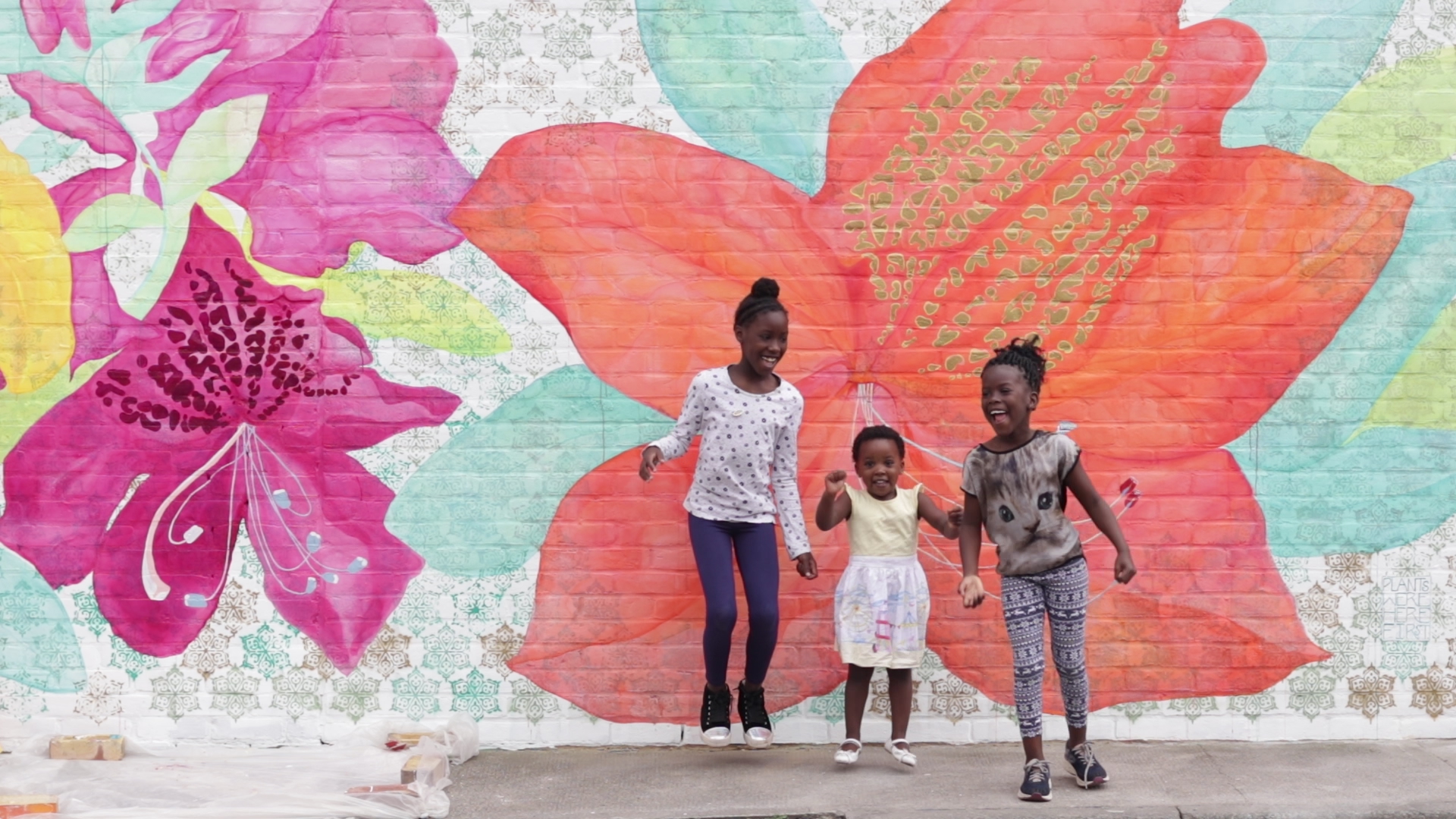
In 2018 I was commissioned to paint a public-facing wall of a private property in Greenwich, south London. As the building is owned by a family with strong links to India, the mural features mandala patterns intermingled with detailed studies of the rhododendron, a plant native to Asia but now widespread and familiar to us all in the UK.
This was my first outdoors mural. It felt important to paint in such a way that the artwork became part of the brick surface, to work with that texture rather than trying to pretend it wasn’t there, and to not worry too much about hiding the artist’s hand. This meant that brush strokes and paint drips were all incorporated into the final work; I wanted it to feel human. I applied the acrylics in thin translucent layers, gradually building punchy colours where needed. It was a time consuming technique but it helped to create a sense of the fragility of the plant, allowing the changing day light to reveal new details, such as petal folds and veins. Rhododendrons are quite mesmerising when studied under the magnifying glass. I wanted to share intimate observations – from curved stamen tubes with eye-like tips topped with pollen to fragile petals stamped with striking, branching patterns – to create a mural that offers a new insight into a plant often only experienced in passing. I find 19th century plant hunters and botanical illustrators fascinating and, while researching this project was particularly drawn to evocative accounts by the likes of Joseph Hooker and Marianne North of encountering rhododendrons in the wild. I really enjoyed the idea of Londoners stumbling across these every-day yet alien plants, re-presented in a spectacle that encourages one to almost step inside the plant, seeing it in a whole new light.
Not a Wallflower
The title of this mural came from the client once the artwork was finished. There’s certainly nothing of the shrinking violet about this painting! and whilst it holds many different meanings and symbolisms for the client, it also contains the evolutionary statement of fact that plants were here before us. I wanted to include this as a nod to our elders and a challenge to our attitude of dominance over the natural world.



Responses
One of the most wonderful aspects of my time painting in East Greenwich was getting to know the local neighbourhood, who were so welcoming and curious about the project. Here are some of their responses:
“I want more and more and more. It is filling a gap of colour and flowers, which we actually haven’t got round this area very much… It’s a grey-ness and a built-up-ness and a concrete-ness (around here), and it’s lovely to have a bit of light and beauty.”
“I live nearby and this mural is so beautiful, it’s made the whole neighbourhood much more colourful. It’s luscious.”
“We are so happy that we have something that attracts people. I was really impressed by the time she put in, she has done something big to the community because you can see this area is full of kids, and you can show your kids so that they have the impression that they can do things like this as well.”
“It is absolutely wonderful, I am captivated. There should be more of these murals on plain walls, we need more. Brightens up your day.”
“It’s an ongoing thing so it’s been lovely Bryony being here for some time and be able to talk about it, and to also talk about it with other neighbours too.”
“It just proves this community is great, I feel proud to be in this neighbourhood.”
“We’re not wallflowers and neither is this mural.”
And from the client:
“Over the years I have commissioned many pieces and exhibitions for the public realm and the experience of working with Bryony was one of the most positive of my career.
I had been following her practice for several years, and always found her approach, and the resulting artwork, to have an extraordinary balance. For Not a Wallflower, she balanced the rigour and planning of academic research, with the flexibility and pragmatism required when working outdoors. The commitment to her preferred subject matter, with a sensitive awareness of what is appropriate in a public space. The inputs of the commissioner, with her vision as the artist. A case in point was her desire to intertwine her points of interest with my family’s story. Having lived in India for many years, it was Bryony’s suggestion to feature the well known and magnificent rhododendron in the mural. The flower is native to the Indian subcontinent, whilst being recognisable in the UK. The work too features Indian mandalas that have spiritual symbolism that is important to me, whilst being a familiar and attractive pattern.
The resulting piece is incredibly strong thanks to its numerous layers. Its surface is a humble, 1970s brick wall, in London’s Zone 2. The surrounding neighbourhood, while grateful for the local Greenwich Park, is choking from pollution from the nearby dual carriageway. For those who walk past, Not a Wallflower brightens an unattractive urban street, injecting some much-needed colour and vivacity to the built up environment. For those who look and linger, it’s hidden message, Plants were here first, is thought-provoking. For those who live in the neighbourhood, it has been a talking point, creating connections between people who reside on the same street, but had never exchanged words.
For the younger members of the community, the future artists and creative practitioners, it is an inspiration. It sends a message that art is important, that it is valued, and to paint it big and bold on a wall is a good and important thing to do. Not a Wallflower is not ‘my commission’, it is no longer even Bryony’s piece. It belongs to the community of SE10 who love it deeply. That is a true and meaningful measure of success.”